Optimized Life
Chapter One: Standard Morning
October 15, 2123, 6:30 AM.
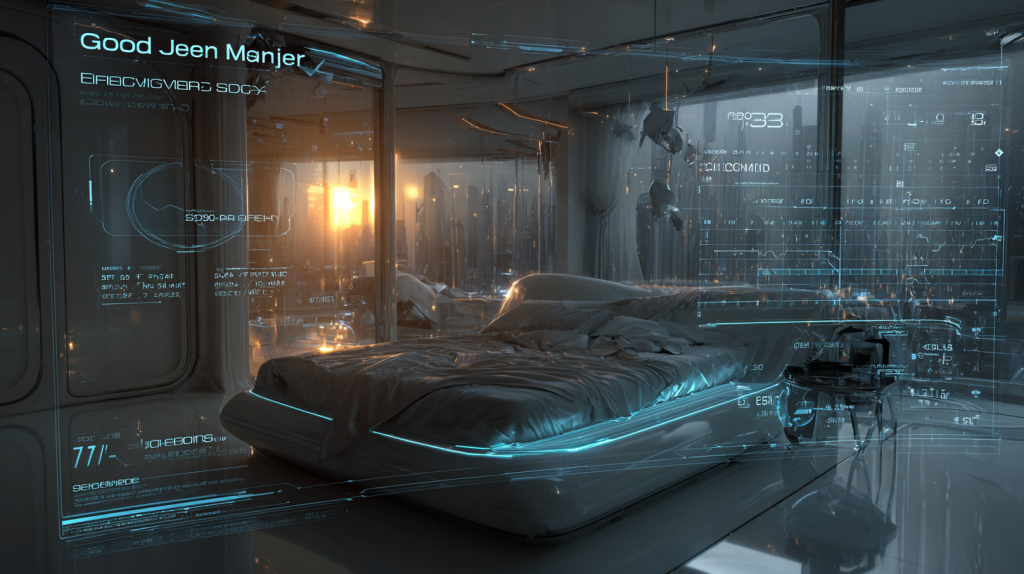
Jennifer Liu’s implant chip activated precisely on schedule, releasing a calibrated dose of wake signals to her nervous system. Her retinal display immediately unfurled:
[Good morning, Jennifer] [Yesterday’s efficiency score: 91.7%] [Today’s weather: Clear, 22°C, Air Quality Index: Excellent] [Today’s schedule: Loaded]
She rolled out of bed, bare feet touching the temperature-regulated floor. The bathroom mirror automatically displayed her physiological data:
- Sleep quality: 87%
- Muscle recovery: Good
- Recommended breakfast: Protein-Enhanced Meal Type A
Jennifer was a mid-level systems analyst at CoreLogic Industries, responsible for optimizing the city’s traffic flow algorithms. It was a respectable position—enough to afford her single apartment on the edge of Civic Core, with some credits left to save each month.
“Play morning briefing,” she told her AI assistant.
“Today’s headlines,” the synthetic voice began. “The Obelisk announces fourth quarter efficiency targets increased by 3%. Veritas Group reports emotion stabilizer usage reaches historic high of 82% this month. Weather forecast…”
Jennifer listened while performing her morning exercises. Her movements were recorded by the implant chip, ensuring she met the company’s “baseline health requirements.”
Chapter Two: Commute Time
7:45 AM, Jennifer left her apartment punctually. In the hallway, she encountered her neighbor Mr. Park, a contract auditor at Helion Trust.
“Good morning, Miss Liu,” he nodded politely.
“Good morning, Mr. Park.”
Their conversation ended there. Under Aegis rule, excessive socializing was considered “efficiency waste.” Everyone had learned to maintain appropriate distance.
The magnetic levitation subway arrived on schedule. Inside the car, passengers stood quietly, most showing the faint blue glow of active retinal displays—processing work emails during commute time.
Jennifer also opened her work interface, reviewing last night’s traffic system performance data. Everything normal, just a few minor congestion points needing adjustment. She quickly wrote optimization code, expecting a 0.3% improvement in traffic flow.
[Work time recording: Started] [Current efficiency: Excellent]
Chapter Three: Office Life
The Obelisk, Level 73, CoreLogic’s Systems Analysis Department.
Jennifer’s workstation was standard issue: holographic displays, ergonomic chair, precisely calibrated lighting. Her colleagues were already at their stations, the office filled only with the soft sounds of typing and equipment operation.
“Liu, good morning,” Department Head Thompson passed by. “Yesterday’s East District optimization proposal was excellent.”
“Thank you, Mr. Thompson,” Jennifer responded, feeling a small surge of satisfaction.
The morning’s work progressed smoothly. She immersed herself in data streams, adjusting parameters, running simulations, watching city traffic flow like blood under her algorithmic guidance. This sense of control gave her a certain… satisfaction? No, the AI assistant would flag such emotion as “over-investment.” She adjusted her mindset, maintaining professional detachment.
11:30 AM, mandatory break time. Employees rose to perform prescribed eye exercises and stretches. Jennifer noticed Kevin in the adjacent workstation taking emotion stabilizers for the third time today.
“Stressed?” she asked quietly.
Kevin forced a smile: “New project deadline. You know how it is.”
She nodded, saying nothing more. Everyone had their own coping methods.
Chapter Four: Lunch Interlude
At lunch, Jennifer chose Nutrition Set B from the company cafeteria. The AI calculated precise calories and nutrients based on her morning exercise and afternoon work schedule.
She sat alone by the window, overlooking Civic Core’s central district. In the distance, other massive buildings stood against the blue sky, each representing different branches of The Aegis Combine.
“Mind if I sit here?”
Jennifer looked up to see an unfamiliar male colleague. He appeared to be in his early thirties, wearing standard CoreLogic uniform, but with something indefinable in his eyes.
“Please,” she responded politely.
“I’m Adrian, just transferred from Data Security,” he introduced himself.
“Jennifer, Systems Analysis.”
They ate quietly for a while. Then Adrian said softly: “Have you ever wondered what would happen if the traffic system failed for one day?”
It was an odd question. Jennifer frowned: “Our redundancy systems would prevent…”
“I mean hypothetically,” Adrian interrupted. “Suppose people had to choose their own routes, without AI guidance.”
“That would be chaos,” Jennifer answered honestly. “Efficiency would drop at least 40%.”
“But maybe,” Adrian mused, “people would discover new routes. Routes the algorithm never considered.”
The conversation made Jennifer uncomfortable. She finished her lunch hastily: “I should get back to work.”
“Of course,” Adrian smiled. “Nice meeting you, Jennifer.”
Chapter Five: Afternoon Fluctuations
Back at her workstation, Jennifer found herself unable to fully concentrate. Adrian’s words echoed in her mind. She tried to focus on the data streams on her screen, but for the first time, those neat numbers felt… monotonous?
[Warning: Focus level decreasing] [Suggestion: Practice meditation or take mild stimulants]
She chose meditation. Closing her eyes, following the AI assistant’s breathing guidance. But in the darkness, she wondered when her life had become so… predictable?
Waking at the same time daily, taking the same route to work, processing similar data, optimizing endless efficiency. She couldn’t even remember the last time she felt genuine… what? Joy? Sadness? Anger? All emotions were regulated within “moderate” ranges.
[Heart rate elevation detected] [Do you need emotional counseling?]
“No,” Jennifer responded quickly, opening her eyes.
She forced herself back to work. But from the corner of her eye, she glimpsed Kevin at his station—filling out an emotional status report, wearing the standard calm expression, but she noticed his hands trembling slightly.
Chapter Six: Unexpected Departure
6:00 PM, standard closing time. But today, Jennifer didn’t stay until 7:30 PM as usual. She packed her things and left the office under her colleagues’ surprised gazes.
[Abnormal behavior recorded: Ended work 1.5 hours early] [Efficiency score: -2 points]
She didn’t care. At least not today.
Exiting The Obelisk, evening sunlight touched her face. Jennifer suddenly realized she hadn’t seen the sun at this hour in a very long time.
Street traffic remained orderly, everyone walking their AI-planned optimal routes. But Jennifer made a small rebellion—she turned into a less efficient alley.
Here were a few inconspicuous shops, not chain brands, probably with low efficiency scores. A used bookstore window caught her attention. Inside, dim lighting illuminated shelves of paper books—these inefficient information carriers had long been replaced by digitalization.
She pushed open the door.
Chapter Seven: The Bookstore

“Welcome,” the proprietor was a man in his sixties. “Rare to see a new face.”
Jennifer didn’t know what to say. She browsed the shelves aimlessly, fingers sliding across yellowed spines.
“Looking for anything special?” the old man asked.
“I… don’t know,” she said honestly.
The old man smiled: “Then just browse. Sometimes, not knowing what you’re looking for helps you find what you need most.”
Jennifer pulled out a poetry collection, opened it randomly: “In the forest of rules, I dreamed of a bird that forgot how to fly…”
The verse made her freeze. When had she forgotten how to dream?
“That’s a banned book,” the old man said softly. “Pre-2115 work. But don’t worry, the shielding here is reliable enough.”
“Why risk keeping these?” Jennifer asked.
“Because,” a light flickered in the old man’s eyes, “someone has to remember that things existed beyond efficiency.”
Chapter Eight: Evening Choice
Jennifer bought the poetry collection, paying cash—another inefficient payment method.
On the way home, her implant chip kept reminding: [Today’s efficiency score: 87.3%] [Below personal average] [Suggestion: Increase work intensity by 12% tomorrow to compensate]
For the first time, she chose silent mode.
In her apartment, Jennifer made real tea—not a nutritionally optimized beverage, just simple tea leaves and hot water. She sat by the window, opening the poetry collection.
Every page spoke of things efficiency algorithms couldn’t quantify: love’s madness, loss’s pain, rebellion’s thrill, the simple joy of existence.
She read until late, until the implant chip forced sleep signals. But before drifting off, Jennifer made a decision—
Tomorrow, she would return to that bookstore.
Not to rebel against anything, just to remember that in this optimized perfect world, she was still human.
Epilogue
2:47 AM.
Jennifer smiled in her dream. She dreamed of walking on a road she’d never taken, not knowing the destination, not caring about efficiency.
Outside, The Obelisk’s blue light still illuminated the night sky, but in one small apartment, a person was dreaming dreams the algorithm wouldn’t approve.
And perhaps, that was enough.