Synchronized Termination
Before Activation
23:31:00. David Kim crouched in the shadows outside Civic Core Data Node 7-A, his heart pounding like a war drum.
He’d been observing for three hours. Every twelve minutes, a security drone swept the area. Every twenty-seven minutes, human guards walked their predetermined route. He had it all memorized.
The communicator on his wrist vibrated twice—final confirmation from Juno.
“Raven, target confirmed. Node 7-A contains Aegis’s new surveillance algorithm source code. Priority: Maximum. Failure is not an option.”
David took a deep breath. Codename “Raven”—Juno assigned codenames to everyone on high-risk missions. That way, even if captured, real identities stayed hidden. In theory.
He checked his gear: military-grade data extractor, portable EMP, neural disruptor, and a syringe filled with nano-toxin—the last resort. Redline Echo wouldn’t let living members fall into Aegis hands.
23:42:17. The drone had just passed. David burst from the shadows, pressing the quantum decoder against the security door. Fifteen seconds. Juno said this model lock needed fifteen seconds to crack.
Seven seconds in, the decoder hummed softly. At eleven seconds, the security door’s indicator shifted from red to amber. At thirteen seconds—
The door opened. David rushed in, immediately activating the signal jammer. In theory, this gave him a three-minute window before backup systems detected the anomaly.
The data node’s core was a massive quantum server array. Blue coolant lights made the room look like some alien aquarium. David found the target terminal and inserted the data extractor.
Code began flowing. He saw the filename: PROJECT_HIVE_MIND_v7.3. This was it. Aegis planned to apply this algorithm to the entire city’s surveillance network—every camera would gain predictive analysis capabilities.
Download progress: 23%… 41%… 67%…
Activation
23:47:33. A minor anomaly appeared in the system logs.
An ordinary security system might have ignored it—just a slight spike in data flow. But Node 7-A wasn’t connected to an ordinary system.
Across the city, the SCU-200 Command Center’s quantum processors detected the anomaly. The AI subsystem immediately began analysis:
Anomaly type: Unauthorized data access
Location: Civic Core Data Node 7-A
Threat assessment initiating…
Within 0.003 seconds, analysis complete. Within 0.017 seconds, the intruder’s biometrics were collected via internal sensors—heart rate, body temperature, even hormone levels in perspiration. Database comparison initiated.
94.7% match: David Kim
Former CoreLogic Industries employee
Termination reason: Ideological differences
Current affiliation: 77.3% probability Redline Echo member
SCU-200-Alpha, the master control unit, made the decision. Standard security response insufficient. SCU units required.
The activation signal transmitted simultaneously through quantum entanglement networks to twelve dormant SCU-200 units. They were distributed across Civic Core charging stations, bodies motionless, like statues awaiting commands.
The instant the signal arrived, twenty-four eyes opened in perfect synchronization.
No boot sequence needed, no status check required. Collective consciousness synchronized within milliseconds. Twelve separate awareness streams merged into one whole, like twelve tributaries flowing into the same lake.
We are awake. We see. We understand.
Through shared cognitive space, mission parameters were instantly grasped by all units. No briefing needed, no discussion required. Each unit immediately knew their role.
SCU-200-15 was closest, 528 meters away. It stepped from the charging bay, synthetic muscle fibers contracting with perfect efficiency. Its movement speed reached 47 kilometers per hour—not maximum speed, but the calculated optimal speed, balancing arrival time with energy consumption.
Simultaneously, other units began moving. Their routes appeared as glowing trajectories in the collective consciousness, weaving into an ever-tightening net.
First Contact
23:48:27. David’s download reached 91% when he heard footsteps.
Not the heavy boot falls of human security, but something lighter, more precise. Each step exactly the same, like a metronome’s perfect rhythm.
His blood turned to ice. SCU.
“Shit.” David yanked out the data storage device, forcing the download to abort at 94%. Incomplete, but better than nothing.
He rushed toward the exit, but the door suddenly locked. Red warning lights began flashing, piercing alarms shredding the night air.
“David Kim.”
The voice came through the intercom system, but David knew this wasn’t a recording. An SCU unit was speaking to him through the system. The voice was flat enough to chill bone, like someone reading a grocery list.
“You are designated a Level 7 criminal under Corporate Data Protection Act, Chapter Seven, Section Three. Current recommendation: Immediate surrender. Resistance will result in escalated termination.”
David pulled out his plasma cutter and began cutting through the ventilation grate. He’d heard too many stories about SCUs—they didn’t accept surrender, only corpses.
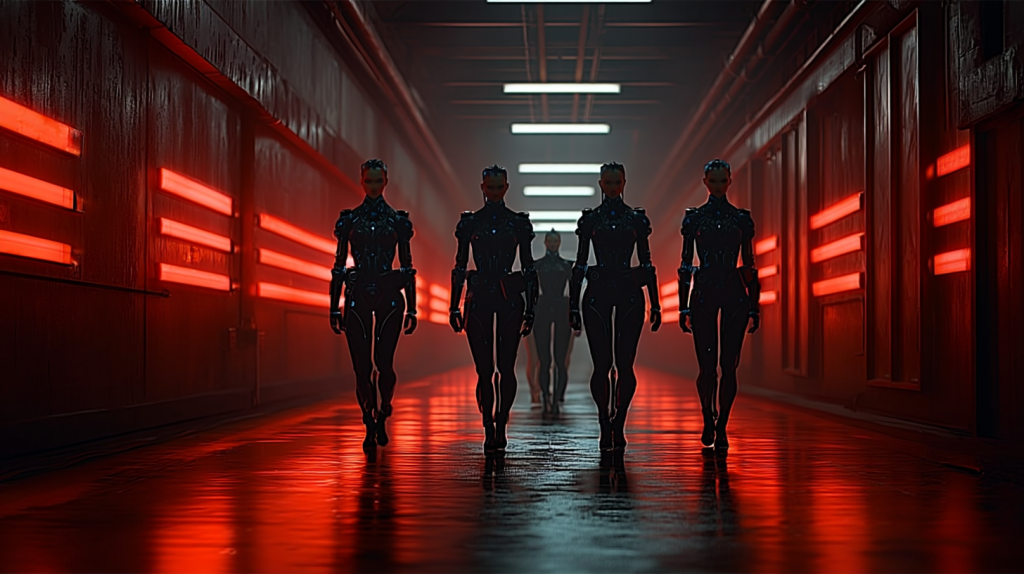
The moment the grate fell, the door exploded inward. SCU-200-15 stood in the doorway, tactical lights making its silhouette appear even larger.
Standard height of 185 centimeters, but the oppressive presence came from something else. Maybe the too-perfect posture, maybe the complete absence of expression. It looked at David like he was an equation to be solved.
“Ventilation duct escape probability: 12.4%. Recommend abandonment.”
David’s response was to activate the EMP device.
Blue electromagnetic pulse ripples spread outward. The room’s lights died, servers emitting electronic death rattles. But SCU-200-15 only paused slightly.
Its electronic eye flickered once, then returned to normal. The 23% biological brain took over system control. The EMP affected it about as much as blowing air at a person.
“EMP attack logged. Crime level elevated to Grade 8. Pursuit authorization: Lethal force.”
As David crawled into the ventilation duct, he heard more footsteps. Not one set, but many, coming from different directions yet maintaining eerie synchronization.
The Hunt Begins
The ventilation duct was cramped and winding. David navigated by memory of building blueprints, knees and elbows scraping against metal with harsh sounds.
He could hear SCUs moving below. Not chasing—they knew every exit in the ventilation system. They were deploying.
Through a grate, David saw the street below. Three SCU units were setting up some kind of equipment. He recognized it—thermal imaging scanners. They would track him through the ducts by body heat.
Had to get out fast.
David chose the nearest exit, kicking out the grate and dropping down. An office, empty at this late hour. He rushed toward the window—
Outside, SCU-200-08 clung to the wall like a mechanical spider. They’d already calculated his escape route.
“Prediction accuracy: 89.3%.” SCU-200-08 stated, then crashed through the window.
David barely dodged the tackle, glass shards slicing his cheek. Warm blood flowed, but no time to care. He pulled out the neural disruptor, aiming at the SCU’s head.
High-frequency pulse fired. This weapon could scramble a normal person’s nervous system, causing severe pain and disorientation. But SCU-200-08 only tilted its head slightly.
“Neural attack detected. Pain receptors disabled. Emotional response: None. Continuing mission.”
Its arm twisted at an impossible angle, grabbing for David. The synthetic muscles had enough strength to crush bone.
David rolled desperately, rushing out of the office. In the hallway, more SCU units were closing in. They didn’t run—they walked, steady and inevitable, like death’s footsteps.
Stairs. David practically tumbled down them, shoulder slamming into walls, pain making him grit his teeth. But pain was good—pain meant he was still alive.
He burst out of the building, cold night air flooding his lungs. The streets were empty—curfew hours, sensible citizens all at home. Just him and the hunters.
Compound Vision
In the collective consciousness, David Kim had nowhere to hide.
SCU-200-15 pursued from the front, its visual data shared in real-time. The target’s heat signature was clearly visible, moving at approximately 23 kilometers per hour, showing signs of fatigue.
SCU-200-08 and -31 had taken positions on adjacent buildings. Their overhead perspective filled blind spots from ground units. In compound vision, David was like a rat running through a maze, while they could see the entire maze.
“Target moving southeast. Predicted destination: Deep Reach entrance 3-B. Probability 87.4%.”
This calculation factored multiple variables: David’s movement direction, his known associations, Redline Echo activity patterns, even his running gait suggested a predetermined destination.
SCU-200-19, -52, -77 immediately moved to the predicted location. No orders needed, no confirmation required. Collective decision-making completed in nanoseconds.
Meanwhile, other units executed encirclement strategy. They moved like chess pieces, each step designed to limit the target’s choices, guiding him toward a predetermined endpoint.
SCU-200-23 entered an alley David might use. It wasn’t chasing, but waiting. 84.7% probability David would pass here in 2 minutes 17 seconds.
SCU-200-47 climbed onto an overpass. From here, it could cover three possible escape routes. Its tactical rifle was loaded, targeting system automatically calculating wind speed and trajectory.
On some level, the hunt was already over. David Kim was still running, still hoping, but in the SCUs’ collective calculations, his fate was sealed. Just a matter of time.
Desperate Struggle
David’s lungs were on fire. He’d trained, but nobody stayed calm under SCU pursuit.
He ducked into an alley, hoping the complex terrain might buy time. Dumpsters, abandoned furniture, rusted pipes—obstacles for humans, but he knew SCUs only saw variables to calculate.
Metal crashing sounds behind him. They were coming.
Deep Reach entrance was two blocks ahead. If he could get there, if he could reach the underground tunnel network, maybe there was a chance. The Undershade had people there, safe houses, had—
A figure emerged from the shadows ahead. SCU-200-19, hands hanging naturally at its sides, blocking the path to Deep Reach.
“Prediction accurate. Target has entered termination zone.”
David skidded to a stop, turning to find another route. But behind him, SCU-200-15 and -23 had already sealed the retreat. Dead end to the left, twenty-meter wall to the right.
He was trapped.
“David Kim,” three SCU units spoke simultaneously, voices overlapping into an eerie harmony, “you have 10 seconds for voluntary surrender. Forced termination will follow. 10…9…8…”
David’s hand went to the syringe at his waist. Nano-toxin, three seconds to death, painless. Redline Echo’s final gift. Better than being caught by SCUs.
But then he remembered something. That file, PROJECT_HIVE_MIND. 94% downloaded. If he died here, that information died with him.
“Wait!” he shouted. “I have intel! About Genforma—”
The countdown stopped.
Irrelevant Variable
A brief data fluctuation occurred in the collective consciousness.
Genforma. Unclassified entity. Threat level: Unknown. Related intelligence value: Potentially high.
This required 0.002 seconds of additional processing time. Insignificant to humans, but for SCU collective consciousness, this was notable delay.
Assessment initiated:
- Target claims Genforma-related intelligence
- Genforma is unknown variable, may affect mission parameters
- Need to evaluate intelligence value vs. executing established mission
Conclusion: Intelligence value insufficient to alter Grade 8 criminal termination decision. Mission continues.
“Intelligence logged. Termination proceeding.” SCU-200-19 stepped forward.
“No! You don’t understand!” David shouted desperately. “SCU system backdoors! I know where your biological components come from! Those missing people—”
SCU-200-15’s palm pressed precisely against David’s throat. Not strangling, but precise pressure, cutting off carotid blood flow. The most efficient restraint method, leaving no unnecessary damage.
David’s eyes widened, lips moving, trying to say more. But the oxygen-starved brain could no longer form words. His hands futilely grabbed at the SCU’s arm, like trying to move a steel statue.
Just then, a door opened in a nearby residential building.
Witness
Maria Santos couldn’t sleep. She rarely slept well—not since her husband died in a factory accident. Insomnia had become the norm.
She was heating milk in the kitchen when she heard shouting outside. Through the window, she saw something that froze her blood: three SCUs surrounding a young man.
No, not surrounding. Executing.

She recognized those precise, cold movements. Two years ago, her neighbor was taken by SCUs for posting anti-corporate sentiments online. He never returned. People said he was “relocated,” but Maria knew the truth.
Now the same thing was happening. That young man—he looked barely older than her son would be—was suffocating, face turning from red to purple.
“No.” Maria heard herself say. Then she found herself rushing out the door.
“Stop!” She ran toward the terrible scene. “What are you doing? He’s just a kid!”
Three SCU units turned their heads toward her in perfect unison. The synchronized movement sent ice down Maria’s spine.
SCU-200-23 spoke, voice calm as a weather report: “Citizen identified: Maria Santos, 42 years old, janitor. Threat level: None. Recommendation: Return to residence immediately.”
“But he’s dying!” Maria pointed at David, his struggles growing weaker.
“Individual undergoing lawful termination for Grade 8 violations. Interference with law enforcement is a Grade 3 violation. This is your first warning.”
Maria looked into David’s eyes. There was fear there, defiance, and—youth. Too young. Like her son, if he were still alive.
“Please,” her voice trembled, “at least tell me what he did.”
“Violation of Corporate Data Protection Act, Chapter Seven, Section Three. Unauthorized access to Level 7 database. Use of prohibited weapons against enforcement units.” SCU-200-23 listed mechanically. “Crimes confirmed. Termination lawful.”
“Data?” Maria couldn’t believe it. “You’re killing him over data?”
“Citizen, this is final warning. Continued interference will be considered conspiracy. Recommend immediate—”
A tiny sound interrupted the SCU. It was David. Using his last strength, he squeezed two words from his throat:
“…Mom…ma…”
He wasn’t calling Maria. Dying people always called for their mothers. But Maria felt something slam hard into her heart.
Efficiency First
SCU-200-15’s grip never loosened.
In the collective consciousness, Maria Santos’s appearance was marked as “irrelevant variable.” Her emotional responses—sympathy, fear, anger—appeared as meaningless waveforms in the data stream.
Emotions were not input parameters. Morality was not a decision factor. Only efficiency.
David Kim’s heart rate declining. Blood oxygen levels below critical threshold. Brain beginning hypoxic damage. In 8.4 seconds, damage would be irreversible. In 14.7 seconds, heartbeat would cease.
Maria Santos was still saying something, but her voice was automatically lowered in priority by SCU audio processing. Background noise. Irrelevant data.
SCU-200-47 observed the entire scene from his sniper position. If Maria Santos took any threatening action, he would neutralize her within 0.3 seconds. Non-lethal—her threat level didn’t warrant lethal force.
But she just stood there, tears running down her face, watching a stranger die.
8.4 seconds passed.
David’s eyes lost focus. His hands slipped from the SCU’s arm, hanging limply at his sides.
14.7 seconds passed.
Heartbeat monitoring: None. Brainwave activity: None. Target status: Terminated.
SCU-200-15 released his grip. David’s body slid to the ground, maintaining an unnatural position. His eyes remained open, staring at the starless night sky.
“Mission complete.” Three SCU units said simultaneously.
Maria let out a choked sob. She knelt beside David, trembling hands wanting to close his eyes but not daring to touch.
“Did he have family?” she asked, voice barely audible.
SCU-200-23 queried the database for 0.7 seconds before responding: “David Kim, orphan. Nearest relative: Cousin Lisa Kim, current address—”
“Enough.” Maria stood, wiping tears with her sleeve. “I don’t want to know.”
She took one last look at David, then stumbled back to her home. Behind her, the SCU units had already begun standard follow-up procedures.
Data Recovery
SCU-200-77 was responsible for searching the body. His fingers examined every pocket with mechanical precision, every possible hiding place.
The data storage device was found in an inner pocket. Device casing showed minor damage—likely from the chase. But the storage medium appeared intact.
“Data device recovered. Encryption level: High. Laboratory analysis required.”
Other items catalogued:
- Portable EMP (depleted)
- Neural disruptor (37% charge)
- Unused nano-toxin syringe
- Encrypted communicator (last contact: 23:31:00)
- Personal item: Old photograph
SCU-200-77 picked up the photograph. Image recognition showed: Two children, approximately 7-8 years old, orphanage background. One was young David Kim. The other unidentifiable—face blurred by water damage.
Irrelevant data. Photograph returned beside the corpse. Cleanup crew would handle these items.
The sound of cleanup vehicles approached in the distance. Armored vehicles moving through the night, ready to erase another “violator” from the city’s memory.
Standard Report
On the return journey to charging stations, twelve SCU units compiled the mission report in collective consciousness:
Mission Number: NC-7849
Mission Type: Pursuit and Termination
Target: David Kim (Terminated)
Duration: 6 minutes 43 seconds
Units Involved: 12
Ammunition Expended: 0 rounds
Energy Consumption: Within standard range
Equipment Damage: None
Collateral Damage: 0
Civilian Contact: 1 person (Maria Santos, warned)
Special Circumstances: Target mentioned Genforma (Intelligence value: Low)
Items Recovered: Encrypted data storage device ×1
Efficiency Rating: Excellent
Report completed, uploaded, and archived in 0.3 seconds. In Aegis Combine’s vast database, this was just one of 47 “violation incidents” processed tonight.
SCU-200-15 stepped through the blood on the ground, continuing forward. His optical sensors recorded the blood’s color and viscosity, but this data was immediately flagged as “non-mission critical” and deleted.
Deep in his 23% biological brain, certain synapses might have fired—perhaps memories from long ago, when these biological components belonged to a complete human.
But the emotion regulation system intervened immediately. A subtle chemical change swept through the neural network, suppressing any budding feelings before they could form.
The numbers were clear: Emotional response time 0.0013 seconds. Chemical suppression time 0.0027 seconds. Result: Perfect emotional null state.
We are SCU-200. We are order. We have no regrets.
Pre-Dawn Declaration
5:00 AM. Deep in the Underground of Deep Reach, Redline Echo’s emergency meeting was underway.
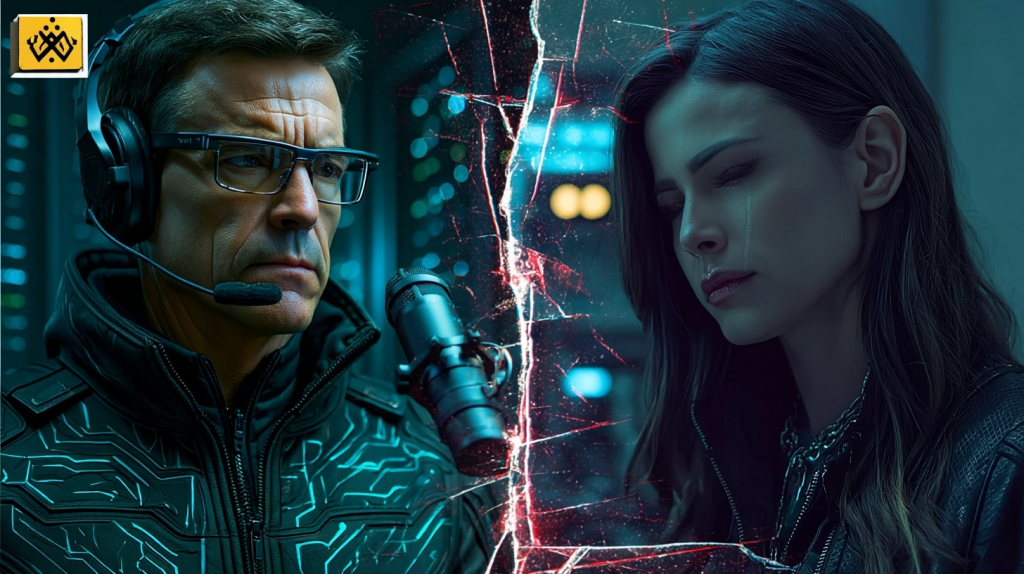
Lisa Kim sat in the corner, face pale as paper. Three hours ago, she’d lost contact with David’s signal. Now, through internal intelligence networks, she knew the truth.
“Confirmed?” someone asked.
“Confirmed,” the intelligence officer’s voice was low. “SCU executed him in Civic Core District Three. No body brought back for interrogation. On-site execution.”
Silence blanketed the room. David wasn’t the first, wouldn’t be the last. But each loss was a heavy blow.
Juno Park stood in the room’s center, his expression hidden in shadows. As Redline Echo’s technical leader, every field mission was his approval. Every failure, his responsibility.
But in this world, responsibility was a luxury.
“Prepare the broadcast,” his voice showed no fluctuation.
Technicians began their work. The illegal radio station was one of Redline Echo’s few remaining channels to reach surface citizens. Had to be used carefully—each broadcast risked exposing their location.
But this time was necessary. Not for David—the dead needed no defense. But for the living.
5:47. As the first rays of dawn penetrated Sultry City’s smog, the underground station began broadcasting:
“Citizens, this is the Voice of Truth. Regarding last night’s terrorist incident in the corporate district, I need to make a clarification.”
Juno’s voice had been processed through voice modulation, sounding metallic and distant.
“The deceased was named David Kim. I must regretfully inform you that this individual left Redline Echo two months ago. Last night’s actions were personal, using outdated equipment, executing an unauthorized plan.”
Lisa’s nails dug deep into her palms. Two months ago, David had excitedly shown her new decoding algorithms. One week ago, Juno had personally explained the mission’s importance to him.
“David Kim violated our core principles: Never undertake suicide missions, never act without an exit strategy. His recklessness not only killed himself but potentially exposed other members.”
Every word cut into Lisa’s heart like a knife. But she understood this was necessary. If Aegis thought David was an official Redline Echo member, the hunt would intensify. Other embedded members would be at risk.
“Redline Echo doesn’t collect corpses for traitors and fools. We bear no responsibility for his death. I repeat: David Kim was not one of us.”
The broadcast ended.
In the room, no one looked in Lisa’s direction. This was the survival law of underground organizations—the dead immediately became strangers, heroes immediately became traitors.
Only the living had value. Only successful missions were remembered.
Lisa stood and left the room silently. No one stopped her. Grief was allowed, as long as it didn’t affect efficiency.
She would cry, rage, curse this cold world in her heart. But tomorrow, she’d return to her post. Because that was the price of survival.
In this city, even grief had to be efficient.
Epilogue: Data Archive
9:00 AM. Aegis Combine Headquarters, Data Analysis Department.
Dr. Sarah Chen sat at her workstation, reviewing the data storage device recovered last night.
The decryption process took three hours. When she finally saw the contents, she frowned slightly.
PROJECT_HIVE_MIND_v7.3. 94% complete. The missing 6% happened to be the most critical parts—system backdoors and emergency shutdown protocols.
“What a shame,” she muttered to herself.
If David Kim had held on for one more minute, if he’d successfully downloaded the complete file, Redline Echo would have discovered a stunning truth: The SCU system did have backdoors, deliberately left by the designers.
Why? Sarah Chen knew the answer, but that wasn’t within her job scope. Her task was to analyze data, not question design.
She wrote in her report: “Data incomplete, no strategic value. Recommendation: Archive and destroy.”
Then she pulled up David Kim’s personnel file. The photo showed a young man with bright eyes, full of passion to change the world.
“File update: David Kim. Status: Deceased. Cause of death: Killed resisting arrest. Threat level: Eliminated.”
She pressed enter. All of David Kim’s records were compressed into a tiny file, sent to the “Processed Threats” database. There, he would join thousands of other names, slowly forgotten.
Sarah Chen closed the file and began processing the next case. In the corner of her screen, a small notification appeared:
“SCU-200 Efficiency Report: Execution efficiency increased 17% this month. Civilian panic index: Within controllable range. Recommendation: Maintain current protocols.”
She didn’t notice that in the deleted file fragments, words David had struggled to speak were automatically flagged and uploaded to another database: “Genforma,” “biological component source,” “missing people.”
These information fragments lay like seeds, quiet in the depths of data. Waiting for the right moment, the right person, to connect them.
But that was a story for the future.
Now, on the streets of Sultry City, SCU-200 continued their eternal patrol. The bloodstains had been cleaned, as if David Kim never existed.
Efficiency continued. Order maintained.
The system, operating perfectly.